

For the past couple of years, I’ve been on a mission to help kids discover their voices. As a child, my voice might not have been the loudest, but I struggled to convey to my teachers why I was so direct and why adapting to new environments was challenging for me.
We understand the importance of setting limits for children’s development. Providing structure helps guide them through the do’s and don’ts. Yet, sometimes, we forget to ask the essential question: How do they feel when facing contradictory rules?
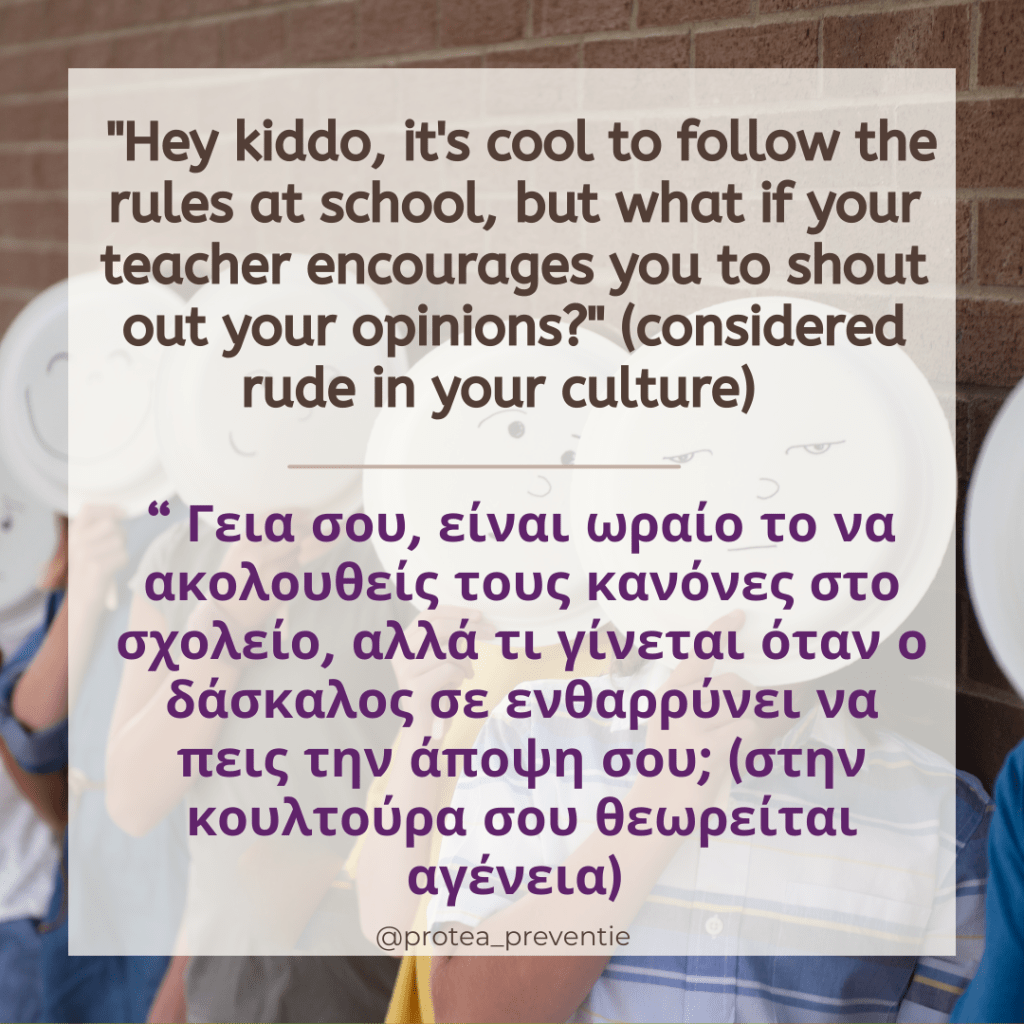
Growing up, I had the privilege of sharing my opinions within my family—a norm accepted by the Luxembourgian educational system but not necessarily by the Greek one. Twenty years ago, I began to wonder: What if my teacher took the time to ask me why I found certain rules difficult to follow? Perhaps she would have realized that my intention was there, but my personal boundaries were strong.
Let’s try something different. Through small, everyday questions, let’s help these young minds express themselves and find their true selves. What we truly need is the ability to adapt to change without compromising our core values.
It’s okay for a child to follow different rules at school and bring them home. It’s not a sign of disrespect but a different perspective. 🌍💬
Empowering Through Understanding
To truly empower our children, we need to understand the challenges they face when navigating diverse cultural and educational environments. The importance of limits in their development is undisputed, but what often gets overlooked is their emotional response to conflicting rules.
As a child, my family provided an environment where sharing opinions was encouraged—a practice well-received in Luxembourgian culture. However, when faced with the Greek educational system, this norm clashed. Reflecting on my experiences two decades ago, I pondered the potential impact of a teacher taking a moment to understand the difficulty I faced in adhering to certain rules.
The Power of Small Questions
Encouraging our kids to express themselves begins with small, everyday questions. It’s about fostering an environment where they feel safe to share their thoughts and feelings. By asking, “How do you feel about the rules at school?” or “Is there something that bothers you about the rules at home?” we open the door to their world.
Children, much like adults, often need validation for their feelings. By acknowledging their emotions and concerns, we empower them to understand and communicate effectively. It’s not just about imposing rules; it’s about fostering a dialogue where they can navigate the complexities of contrasting expectations.
Adaptability Without Compromise
Adaptability is a crucial skill, both in childhood and adulthood. The ability to navigate different rules and expectations prepares children for a diverse world. However, it’s equally important to emphasize that adaptability doesn’t mean compromising core values.
As a child, I grappled with the challenge of adhering to different sets of rules in Luxembourg and Greece. It wasn’t a matter of disrespect but a clash of perspectives. Kids can seamlessly switch between various rule sets, and it doesn’t diminish their respect for parental authority.
Encouraging Individuality
Each child is a unique individual with their own set of values and perspectives. Empowering them doesn’t mean enforcing uniformity but celebrating diversity. By giving them the space to express their opinions, even if they differ from the established norms, we nurture a sense of individuality.
Imagine a child who feels heard and understood, free to bring their thoughts from school to home without fear of judgment. It’s a powerful affirmation that their voice matters and that their identity is respected.
The Role of Curiosity
Curiosity is a driving force in both childhood development and adult self-discovery. Encouraging children to question, explore, and understand the reasoning behind rules is instrumental in their growth. Instead of presenting rules as rigid constraints, we can frame them as guidelines, open for discussion.
For instance, instead of saying, “You must follow your teacher’s instructions,” we can pose a question like, “What do you think about expressing your opinions in class?” This shift invites curiosity and helps children internalize the reasoning behind rules.
The Professional Parallels
Drawing a parallel between childhood experiences and the professional world emphasizes the continuity of these lessons throughout life. Just as children navigate different rules at home and school, adults encounter varying expectations in different professional settings.
Encouraging children to adapt to diverse rules prepares them for the dynamic nature of the workplace. However, just as we ask children about their feelings regarding contradictory rules, adults should reflect on how they navigate conflicting expectations in their professional lives.
Nurturing Voices, Shaping Futures
In conclusion, empowering kids to find their voices is a transformative journey—one that extends beyond childhood into adulthood. By understanding the emotional shades of conflicting rules, encouraging curiosity, and emphasizing adaptability, we pave the way for confident, resilient individuals.
As parents, caregivers, and educators, we play a pivotal role in shaping the narrative of our children’s lives. Let’s create environments where their voices are not only heard but celebrated. It’s not about stifling individuality but fostering a generation that can confidently navigate diverse landscapes while staying true to their core values.






Leave a Reply